
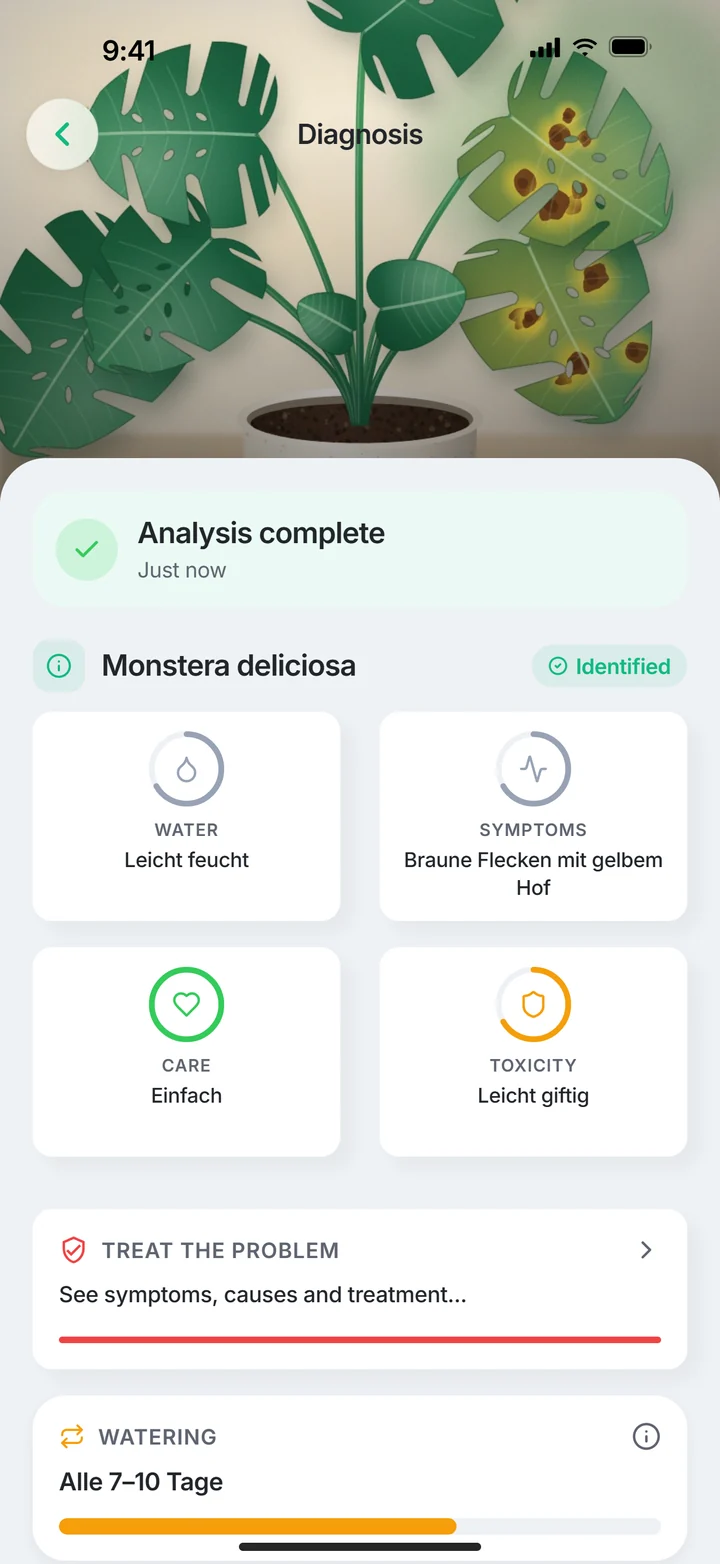
Possible causes remain possibilities. Compare soil, location and changes before adding care tasks.
Read the overall assessment first
Read the interpretation and guidance on symptoms, water, light and care. Does the suggested identification look plausible? If the species is uncertain, also treat species-specific care advice cautiously. The analysis can be wrong.
Compare suggestions with observations
Take each important suggestion individually: what supports it, and what does not fit? A suggestion of dryness needs checking against soil that is actually wet. A recent move or repotting may add a useful explanation.
Choose treatment and tasks deliberately
Read the steps fully. Add only tasks that fit what you found and that you understand how to carry out. Avoid changing water, fertiliser and location together just in case. Expert confirmation is especially useful for products or major interventions.
Watch the plant’s progress
Keep starting photos and a record of the adjustment you chose. Look for new damage and fresh growth. Seek horticultural advice for rapid decline, conflicting clues or uncertain severe damage. Do not rely on the app alone for toxicity or consumption decisions.
Test a suggestion with two questions
Ask what supports an important cause and what conflicts with it. Suggested thirst may fit a dry light ball; persistently wet mix needs further investigation. A silvery area alone does not confirm an animal. Record a contradiction rather than reinterpreting the plant until every answer sounds correct. Analysis guides from available images. Your knowledge of location and history adds context and may limit a suggestion. Comparing evidence is more useful than treating the first named cause as established.
Turn suggested actions into a sequence
Begin with a reasoned check such as opening the outer pot or examining an underside. A relevant finding leads to the next action. A result list is not an instruction to do everything simultaneously. Read conditions and directions fully and seek confirmation for products or major interventions. If adopting a task, keep its purpose clear. Completed means the step was done; it does not establish a cause or prove that the plant has recovered.
Leave uncertain identification open
A species name affects whether water and light advice makes sense. Compare identification with label, growth and a reliable species source. If uncertain, keep it an open question. Edibility and toxicity need particularly reliable identification and appropriate specialist sources. A photo result alone is insufficient for that decision. You can still inspect visible damage and pot conditions and prepare advice without converting an uncertain name into a confirmed fact or treating associated care requirements as guaranteed.
Your quick check
- Does the assessment fit the actual plant?
- Which observation supports the suggested cause?
- What information is still missing?
- Which single next step can you explain?
Common questions about this topic
Is the severity a reliable prediction?
No. It is an assessment based on available information, not a guarantee of what will happen.
Can I decide toxicity from this alone?
No. Use reliable species-specific sources and expert advice for toxicity or consumption questions.